Every year, roughly 1.3 million wildebeest march through the Serengeti and Maasai Mara in a loop chasing rain and fresh grass. If you’re asking how many wildebeest die during migration, you’re probably picturing the Mara River crossings you’ve seen in documentaries and wondering just how brutal that journey really is. The short answer: it’s significant, but it’s also part of a system that’s kept this migration running for thousands of years.
Estimates put the annual death toll between 250,000 and 500,000 wildebeest, out of a herd that numbers over a million. That’s not a random figure. It comes down to a handful of specific killers: crocodile attacks and drowning at river crossings, exhaustion from covering nearly 500 miles a year, and predation from lions, hyenas, and cheetahs picking off the weak or the young.
This article breaks down the real numbers behind those deaths, explains why the crossings turn so deadly, and looks at how this brutal math actually keeps the Serengeti ecosystem healthy. If you’re planning to witness the migration yourself, we’ll also touch on when and where the action is most dramatic, information our guides at La Zanna Tours use every day to time your safari right.
Why so many wildebeest die during the migration
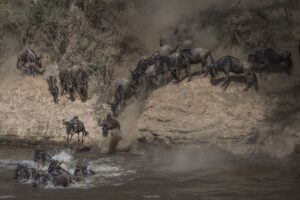
The Mara River crossings get all the attention, and for good reason. Nile crocodiles, some over 16 feet long, lie in wait in the deeper channels where the current is strongest. When a herd panics at the riverbank, thousands of animals push forward at once, and the ones at the front get shoved into water they never meant to enter. Drowning kills more wildebeest during a single crossing than crocodile jaws do. Steep banks, sudden currents, and sheer crowd panic turn a 30-second swim into a death trap for the unlucky ones caught in the crush.
A single bad crossing can kill more wildebeest in ten minutes than lions do in a week.
Exhaustion is the quieter killer. Wildebeest migration routes cover close to 500 miles a year across dry, cracked terrain with little water between refuges. Calves and older animals fall behind, dehydrate, or simply collapse from the pace. Add in broken legs from rocky riverbeds and stampede injuries, and you get a steady background death rate that has nothing to do with predators or rivers at all.
Then there’s straightforward predation. Lions, hyenas, and cheetahs time their own reproduction to the migration’s arrival, and they target the young, the sick, and the stragglers at the back of the herd. It’s not random slaughter, it’s selective pressure that has shaped this ecosystem for millennia.
Here’s roughly how the annual death toll breaks down:
| Cause of death | Estimated share of annual deaths |
|---|---|
| Drowning and crocodile attacks at river crossings | 15-20% |
| Exhaustion, dehydration, and injury | 40-45% |
| Predation (lions, hyenas, cheetahs) | 35-40% |
These numbers shift year to year depending on rainfall and river levels, but the pattern holds. Most wildebeest don’t die dramatically in a crocodile’s jaws, they die quietly from the grind of the journey itself, which is exactly what keeps the migration’s numbers in check without wiping out the herd.
Why these deaths sustain the Serengeti-Mara ecosystem
Nutrients from the dead don’t just vanish. Carcasses left in the Mara River feed a whole chain of scavengers, from vultures and marabou storks down to catfish and the crocodiles that pulled the animal under in the first place. Researchers studying the river have found that decomposing wildebeest deposit tons of nitrogen and phosphorus into the water each season, which drives algae growth and feeds fish populations that other predators depend on. Nutrient cycling on this scale doesn’t happen without a die-off this large.
Population control matters just as much. The Serengeti’s grasslands can only support so many grazers before the land gets stripped bare, so population control through death is what keeps the herd from outgrowing its own food supply. Without a die-off of a few hundred thousand animals a year, the remaining grass wouldn’t recover fast enough, and you’d see mass starvation instead of a manageable, if brutal, annual cull.
The wildebeest that don’t survive the crossing are what keep the ones that do alive.
Predators time their whole year around this cycle too. Lion prides and hyena clans along the migration route sync their birthing seasons to the herd’s arrival, and crocodile populations in the Mara River have grown noticeably fatter and more numerous thanks to this predictable annual feast. Take the deaths out of the equation, and you don’t just lose wildebeest, you destabilize the entire food web that depends on them.
How to witness river crossings safely and responsibly
Timing determines everything. River crossings happen most reliably between July and October, when the herd pushes north into the Maasai Mara chasing fresh grass, then again around October and November as they head back south, so it pays to check which months suit a Tanzania safari before you book. Watching from a fixed vantage point on the Kenyan side is common, but the Tanzanian side of the Mara River, inside the Serengeti, offers fewer crowds and just as much drama if your guide knows the current herd movements.
Choosing the right vantage point
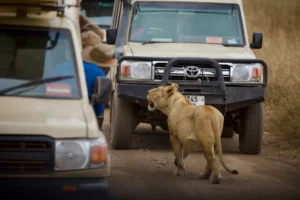
Getting too close changes wildebeest behavior, and a spooked herd can abort a crossing or panic mid-river, which raises the death toll unnecessarily. Good operators keep vehicles at a respectful distance, use elevated riverbanks instead of crowding the water’s edge, and let the herd decide when to cross rather than pressuring it with engine noise or repositioning vehicles mid-crossing.
The best crossings are the ones the wildebeest choose on their own timing, not the ones tourists rush them into.
Responsible viewing comes down to a few habits:
- Stay inside the vehicle during active crossings
- Keep engine noise and movement to a minimum near the riverbank
- Follow park ranger and guide instructions on crossing points
- Avoid pressuring guides to "chase" a crossing that hasn’t started naturally
Visitors booking a migration-focused Serengeti package through operators who track daily herd positions get better odds of seeing a real crossing without contributing to the chaos that kills more animals than it needs to. La Zanna Tours builds its 5-day Mara River crossing itinerary around exactly this kind of patient, low-impact positioning.
Key facts and numbers behind the wildebeest migration
Numbers tell the story better than description alone here. The herd itself sits at roughly 1.3 to 1.5 million wildebeest, joined by around 200,000 zebra and 400,000 Thomson’s gazelle that travel alongside them for safety in numbers. Annual mortality lands between 250,000 and 500,000 animals, meaning the herd loses somewhere between a fifth and a third of its population every single year and still rebounds.
Births keep the math working. Roughly 500,000 calves are born within a tight three-week window each February, mostly on the short-grass plains of the southern Serengeti, and that synchronized birthing overwhelms predators with more prey than they can possibly eat. It’s a numbers game the wildebeest win by flooding the system all at once.
More wildebeest are born in three weeks than die in an entire year, which is exactly why the herd keeps growing back.
Specific figures worth knowing:
| Statistic | Approximate figure |
|---|---|
| Total herd size | 1.3-1.5 million wildebeest |
| Annual deaths | 250,000-500,000 |
| Annual calf births | ~500,000 |
| Distance traveled per year | ~500 miles |
| Major crossing points | Mara River, Grumeti River |
Grumeti River crossings happen earlier in the cycle, usually June, and carry their own risk from large crocodiles despite drawing less attention than the Mara. Together these figures explain why the wildebeest population has stayed remarkably stable near 1.3 million for decades, even with a death toll that would collapse most other species.
Witnessing nature’s toughest journey
The wildebeest migration isn’t a nature documentary highlight reel, it’s a survival story that plays out with real losses every single year. Between 250,000 and 500,000 wildebeest don’t make it through the crossings, the exhaustion, or the predators waiting at the riverbank, and that death toll is precisely what keeps this ecosystem balanced for the next generation. Understanding that math changes how you watch a crossing unfold. You stop seeing chaos and start seeing a system that’s worked for thousands of years, one that rewards patience over pressure and timing over luck.
Getting the timing right is the difference between watching from a crowded riverbank and having a genuine, low-impact front-row seat. Guides who track herd positions daily, not seasonal averages, put you in position for a real crossing without adding to the risk. If you want that kind of planning behind your trip, take a look at our 8-day Great Migration summer safari in Tanzania and let local expertise time it right.